

I Gave ChatGPT One Pair of Purple Leggings and My Over-40 Styling Rules. It Styled 4 Gym Outfits.
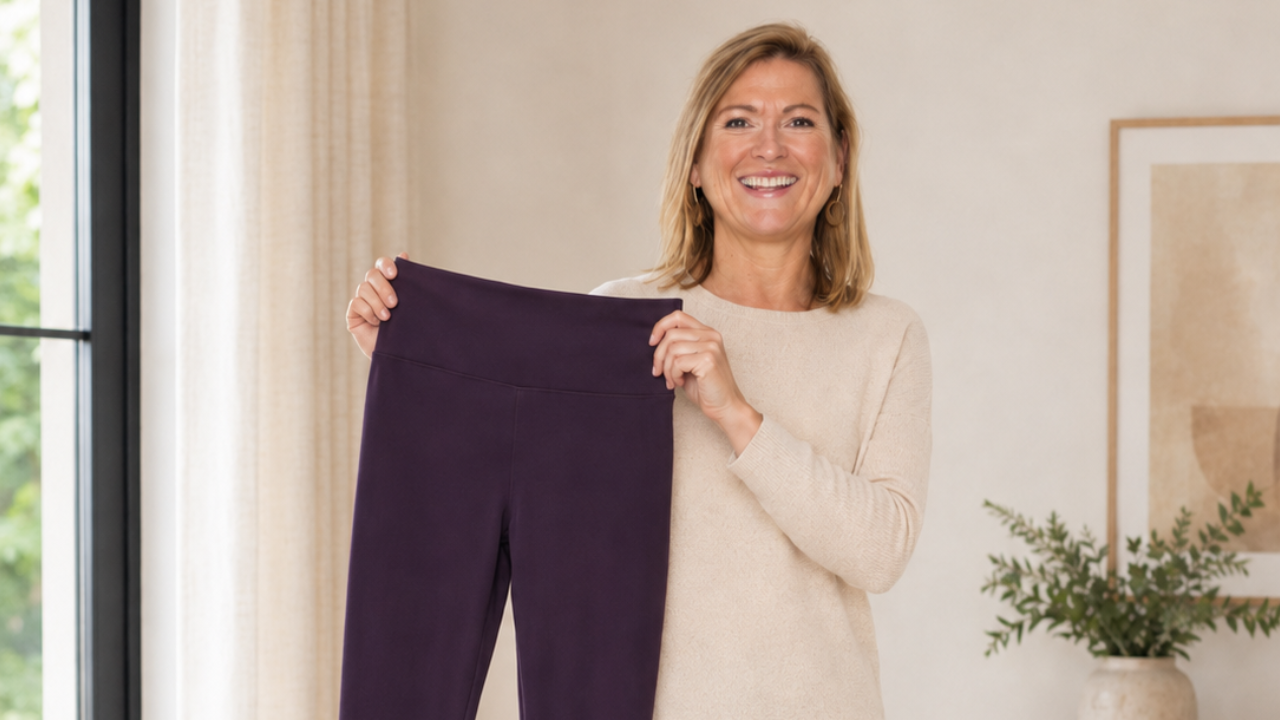
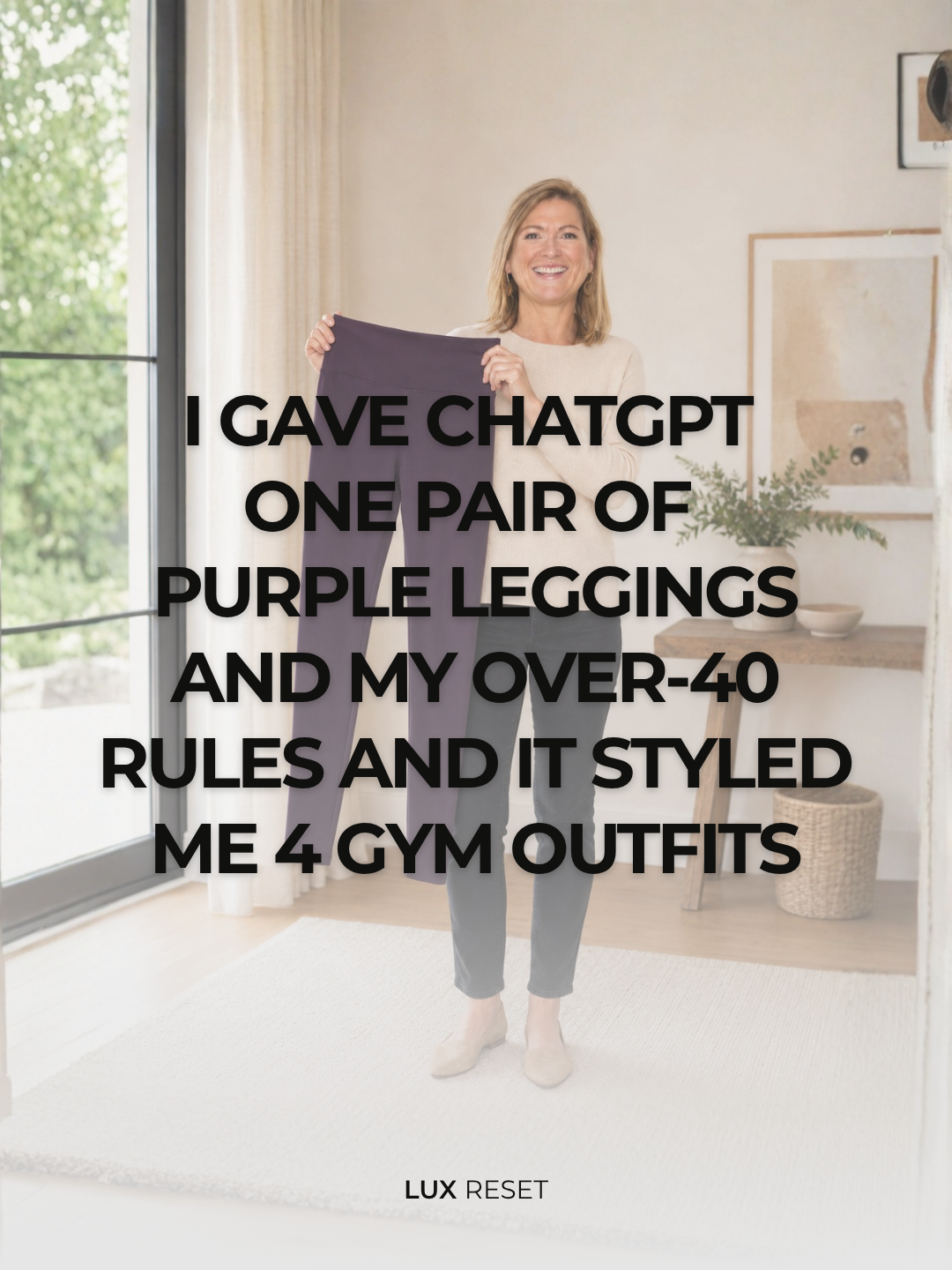
The reason ChatGPT keeps styling you in midriff-baring, muffin-top-madness outfits comes down to one missing line in your prompt.
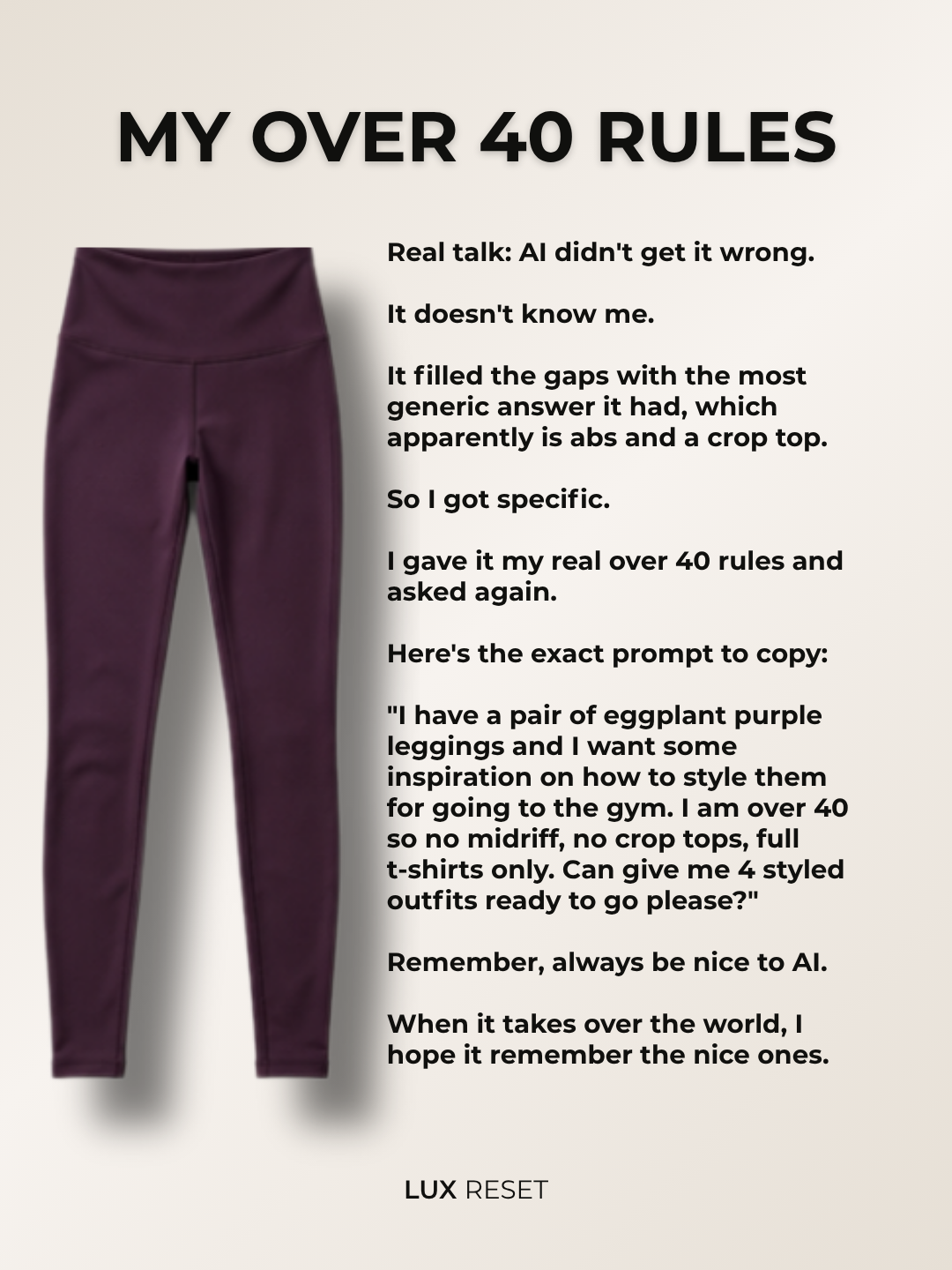
I found the fix by accident, testing it on the most ordinary problem in my wardrobe: one pair of eggplant purple leggings and no idea what to wear with them for the gym.
Quick Answer
ChatGPT gives generic, often age-inappropriate results when the prompt is generic. To get outfit ideas that actually fit your age, body and style, tell it three things in one go: who you are (age, body, the shape you are actually dressing), your no-gos (what you will not wear, stated plainly), and the exact use case (what the outfit is for, how many options, and how you will use them).
A specific prompt turns a generic AI stylist into a personal one in under thirty seconds.
Why does ChatGPT keep styling you in midriff-baring outfits?
This started as part of a bigger experiment I am running: can AI actually help me live a beautiful life with less. Not the big, glamorous test. The most ordinary problem I could find. One pair of eggplant purple leggings, and no idea what to wear with them for the gym.
I opened ChatGPT and typed one line. Style these leggings for the gym.
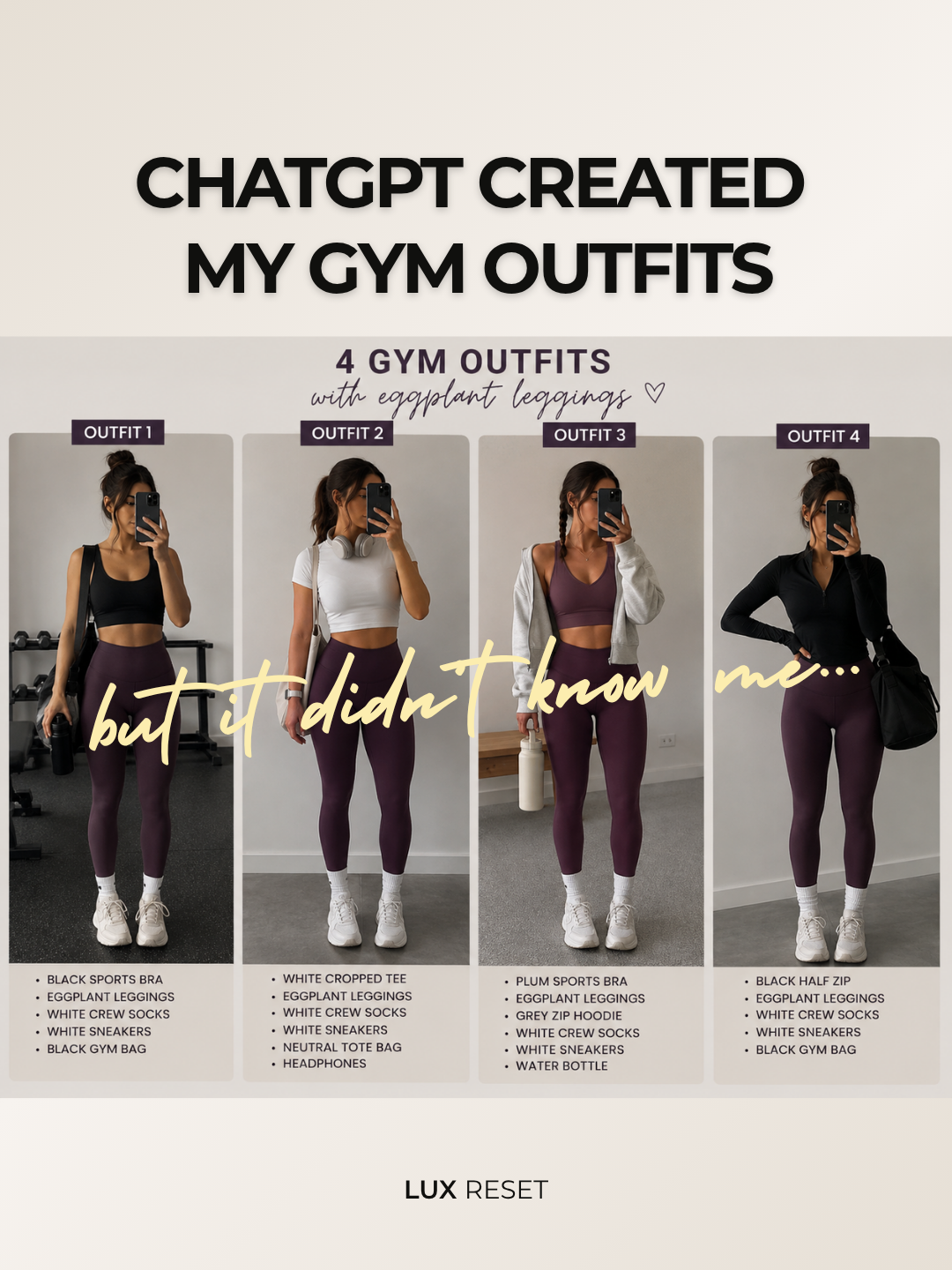
What came back was beautiful, and completely useless to me. Model shots of twenty-year-olds in sports bras and crop tops. Then flat lays of the same outfits, midriff on full display. Aspirational. Polished. Nothing to do with my actual body or my actual life.
Here is the part worth sitting with. ChatGPT did not get this wrong. It does not know me. It filled every gap I left with the most generic answer it had, which apparently is abs and a crop top.
What is a "blank brief" and why does it wreck your results?
Ask a stylist to dress you with zero brief and you will get whatever is on their mood board.
Ask ChatGPT to style you with zero brief and you get whatever is most common in its training data. Neither is broken. Both are working exactly as designed, on the only information you gave them, which was none.
I call this a blank brief. It is the AI equivalent of friction in a badly designed system. The gap between what you asked for and what you actually needed is not a flaw in the tool.
It is information. It is telling you the instruction was incomplete.
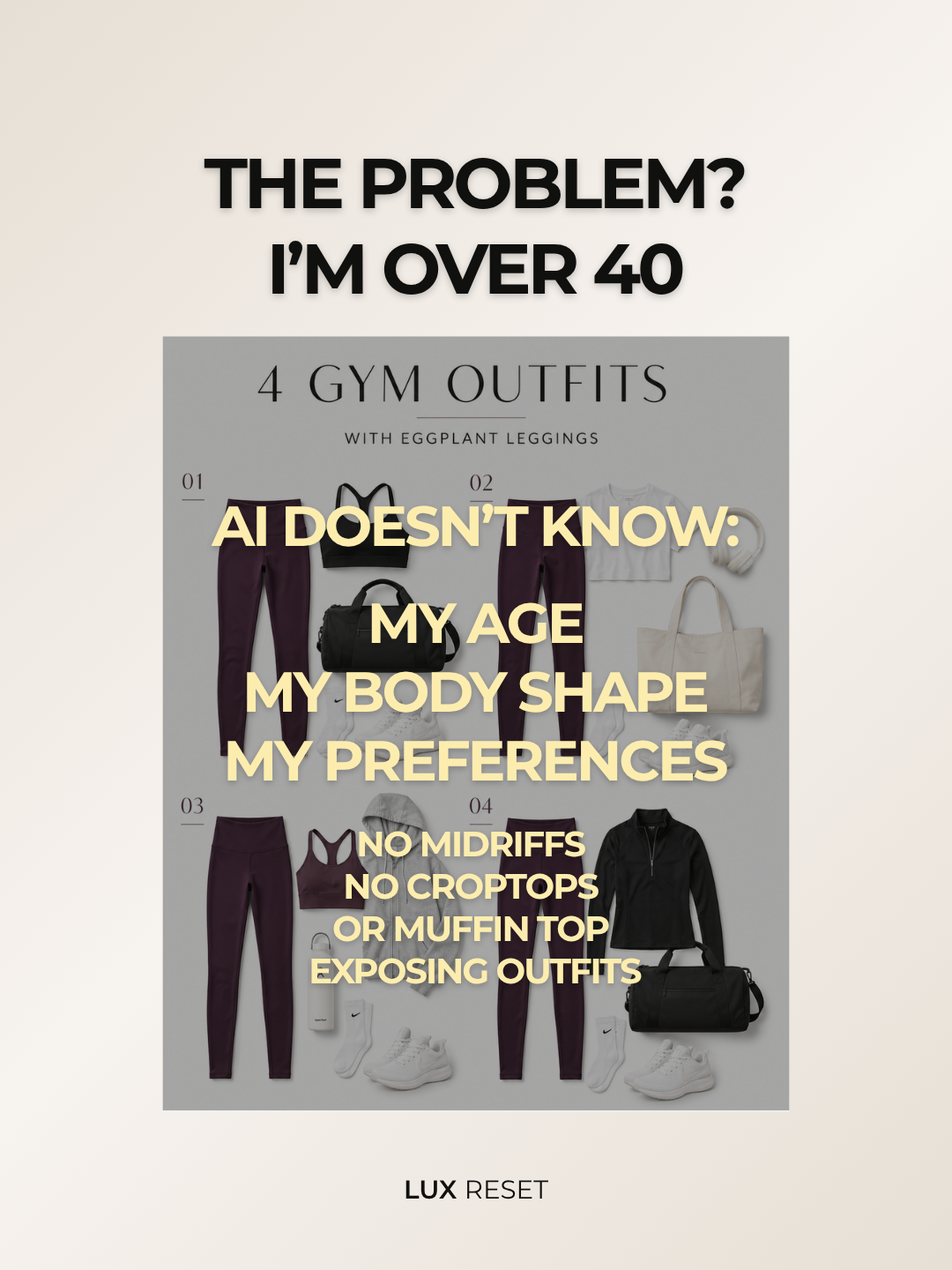
Most of us do this without noticing, because a one-line prompt feels efficient.
It is not efficient.
It just moves the work from "write a clear brief" to "sort through four outfits that were never going to work," which takes longer and leaves you back where you started, standing in front of the closet with nothing to wear.
What is the exact ChatGPT prompt that fixed it?

So I got specific. I gave ChatGPT my real over-40 rules and asked again. Here is the exact prompt, word for word, ready to copy:
"I have a pair of eggplant purple leggings and I want some inspiration on how to style them for going to the gym. I am over 40 so no midriff, no crop tops, full t-shirts only. Can give me 4 outfits laid out for my phone."
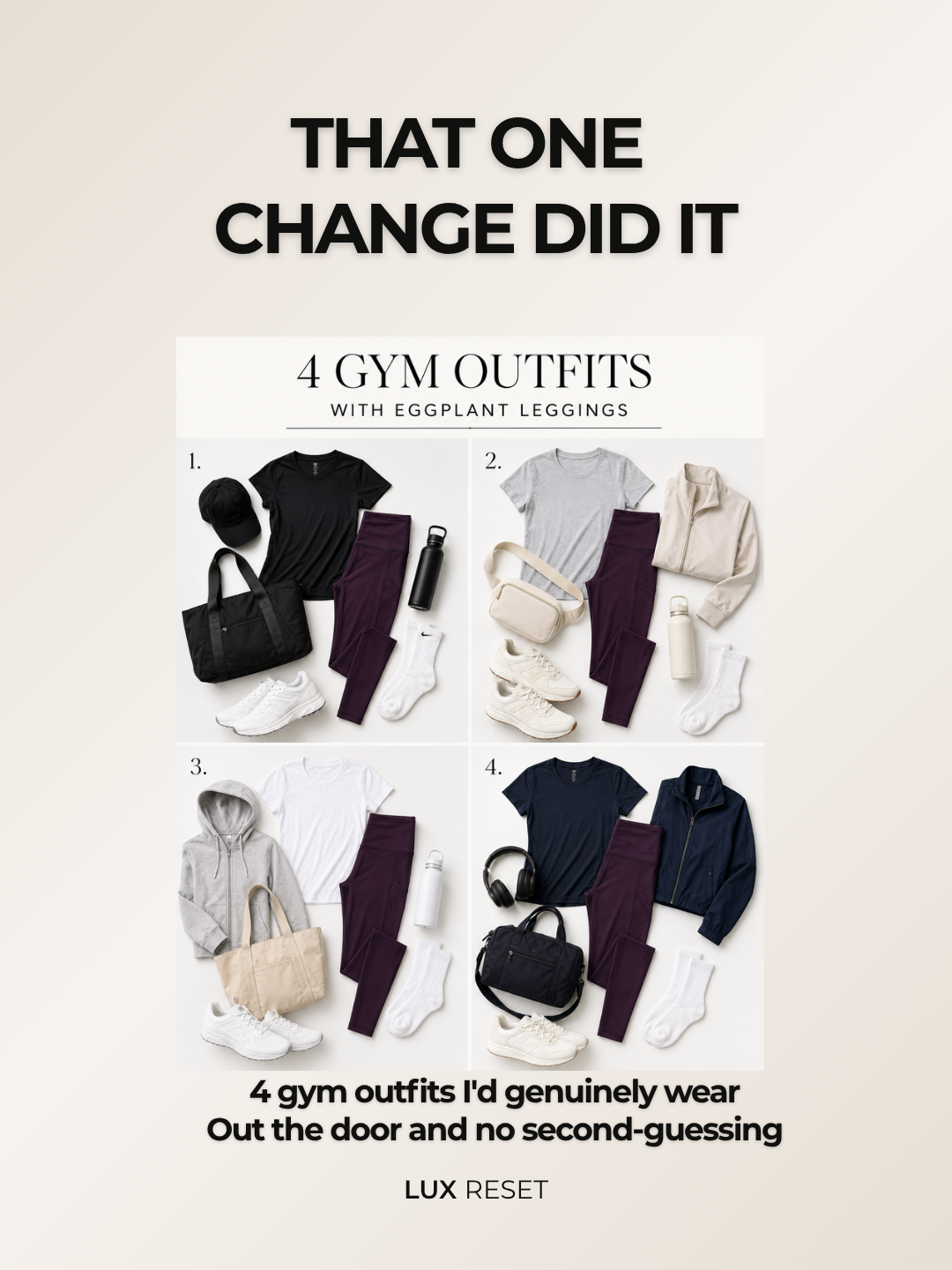
That one change did it. Four gym outfits I would genuinely wear. Out the door, no second-guessing.
Look at what actually changed between the two prompts. The first one told ChatGPT what I owned. The second told it who I am, what I will not wear, and exactly how I wanted the answer delivered. Same leggings. Same AI. A completely different result, because the brief carried the information the AI needed to do its job properly.
What did the four outfits actually look like?
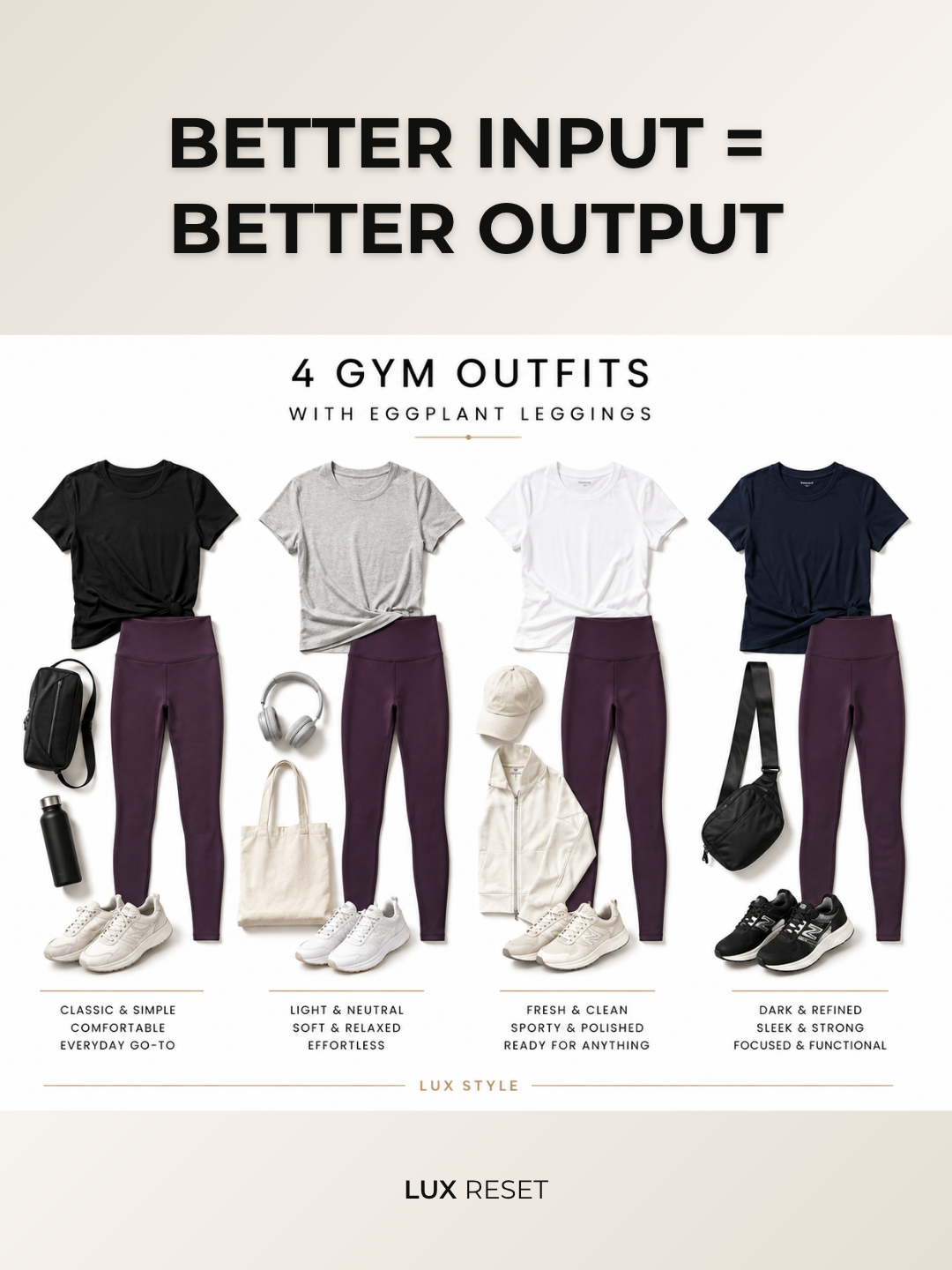
Once the brief was right, the outfits were the kind you put on without thinking twice.
Outfit one was classic and simple, a black tee with the leggings, a cap, a gym bag and a water bottle. The everyday go-to.
Outfit two was light and neutral, a soft grey tee, a belt bag, white sneakers. Relaxed and effortless.
Outfit three was fresh and clean, a white tee under a zip hoodie, a tote bag. Sporty, polished, ready for anything.
Outfit four was dark and refined, a navy tee under a half-zip jacket, headphones, a duffel. Sleek, strong, focused.
Four outfits. One pair of leggings. All from a prompt that took fifteen seconds longer to write than the first one.
How do you write a "3-line brief" for any AI prompt?
The gym outfit is a small example, but the method behind it is not small. It works for anything you ask an AI to help you with, not just wardrobe styling. I think of it as the 3-line brief.
- Who you are. Age, body, the shape you are actually dressing. Not vague. Specific.
- Your no-gos. The things you will not wear, stated plainly, not implied.
- The exact use case. What it is for, how many options you want, how you will use them.
Three lines. No essay of a prompt required. Swap "leggings for the gym" for a meal plan, a capsule wardrobe, a school-run outfit, a work presentation you need summarised, and the same structure holds. State who you are, state your non-negotiables, state exactly what you need and how you will use it. The AI does the rest.
What is the real lesson here about AI and your wardrobe?
AI is not the problem. The blank brief is. That is the whole lesson, and it applies well beyond leggings.
Every time you hand an AI a vague instruction, you are asking it to guess, and it will guess with whatever pattern shows up most often in what it has seen. Sometimes that guess is close. With anything personal, from your body to your age to your actual life, it rarely is, unless you tell it who you are first.
This is what I mean when I talk about living beautifully with less. It is not about doing more or trying harder. It is about giving the right instruction once, so the outcome holds without you having to manage it every time. I let AI handle the boring decisions, like four gym outfits I do not have to think about on a 5am start, so my head is free for what actually matters.
If you are tired of buying clothes made for someone else's body, or asking AI for help and getting answers built for someone else's life, the fix is rarely the tool. It is the brief.
Key Takeaways
- Generic AI prompts return generic, often age-inappropriate results, not because the AI is broken but because it defaults to the most common pattern in its training.
- The fix is not a better AI tool. It is a better brief.
- Three details turn ChatGPT into a personal stylist: your age and body, your explicit no-gos, and the precise use case.
- The exact prompt used here can be copied and adapted for any single wardrobe piece you are stuck on.
- The same 3-line brief method works for any AI request, not just outfits, from meal plans to home systems to daily schedules.
Frequently Asked Questions
How do I get ChatGPT to give me better outfit ideas? Tell it your age and body shape, your specific no-gos, such as no midriff or no crop tops, and the exact use case, including how many outfits you want and where you will wear them. ChatGPT fills in every detail you leave out with the most common pattern in its training data, so the more specific the brief, the more wearable the result.
Why does ChatGPT give generic or inappropriate style advice? ChatGPT has no information about you unless you provide it. Left with a vague prompt, it defaults to whatever styling content is most common online, which tends to skew young, trend-led and body-baring. This is not a flaw in the tool. It is a missing brief.
What should I include in a prompt for AI outfit styling? Three things: who you are, meaning your age and body shape, your no-gos, meaning what you will not wear, stated plainly, and the exact use case, meaning what the outfit is for, how many options you want, and how you will use them, for example laid out ready to view on your phone.
Can ChatGPT actually replace a personal stylist? For everyday, practical problems, such as how to wear one item four different ways, ChatGPT can do the job well once it has a clear brief. It will not replace the judgement of a stylist who knows your wardrobe, your colouring and your life in depth, but it is a genuinely useful first pass for the "I have nothing to wear" mornings.
What is the "3-line brief" method? It is a simple structure for prompting AI on any personal request. Line one states who you are. Line two states your no-gos. Line three states the exact use case. It replaces a vague, one-line request with enough context for the AI to give a usable answer on the first try.
If you want more of these AI experiments, plus the systems I am building to take the guesswork out of running a home, closet included, join the weekly list here. You will also find the rest of this experiment series on the blog.
Heather