

What Dolly Parton Knew About Personal Style, Knowing Your Worth and Becoming Unforgettable
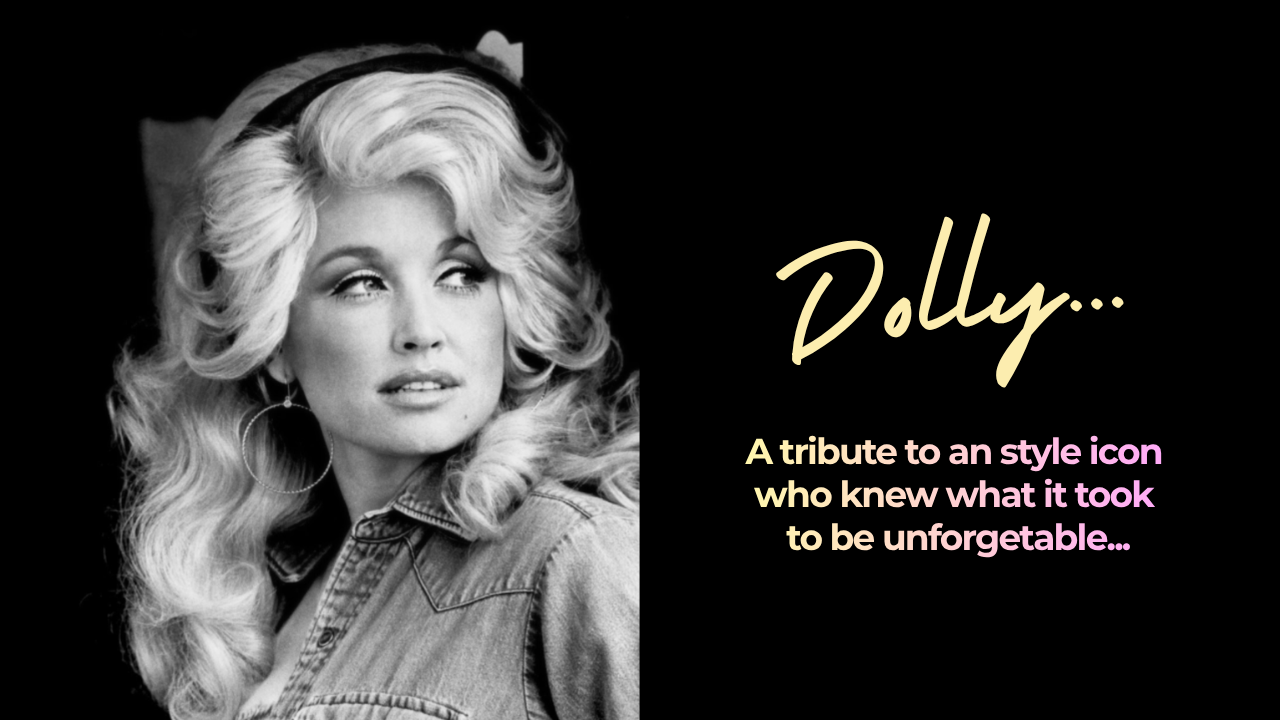
There are people who have great style.
And then there are people whose style becomes so completely entwined with who they are that you cannot separate the person from the look.
Dolly Parton was one of those people.
The hair.
The heels.
The nails.
The tiny waist.
The rhinestones.
The unapologetic quantity of absolutely everything.
You could see a silhouette from the back of a theatre and know it was Dolly.

But I think we sometimes mistake what made her remarkable.
It wasn't simply that Dolly had an outrageous wardrobe.
It was that Dolly knew exactly who Dolly was.
And she spent a lifetime having the confidence to keep showing us.
Dolly didn't follow fashion. She followed Dolly.
Long before celebrity stylists, personal brands and Instagram aesthetics, a little girl growing up in the mountains of East Tennessee had already found her style inspiration.
And it wasn't in Vogue.
Dolly often told the story of a glamorous woman who lived in town.
She had peroxide-blonde hair piled high on her head. Red fingernails. Red lipstick. Powdered cheeks. High heels.
Little Dolly thought she was magnificent.
Her mother had a rather different assessment.
The woman, she told Dolly, was "trash."
Dolly's response was essentially:
Excellent. That's what I want to be when I grow up.
Years later, Dolly described that woman as the prettiest thing she'd ever seen.
That story tells you almost everything you need to know about her.
Even as a child, she wasn't choosing according to other people's rules about what was tasteful.
She noticed what delighted her.
And she remembered it.
As her career grew, that childhood idea of glamour became bigger.
Much bigger.
Big hair.
Big heels.
Big personality.
And way more rhinestones than were strictly necessary.

Critics sometimes suggested she might have been taken more seriously if she dressed differently.
Dolly knew.
She just didn't particularly care.
She once joked that it cost a lot of money to look as cheap as she did.

That joke worked because she was completely in on it.
The clothes weren't wearing Dolly.
Dolly was wearing the clothes.
The outrageous look was actually incredibly clear
This is where I think Dolly's style becomes fascinating.
Because from the outside it looks like excess.
From a design point of view, it was actually extraordinary consistency.
She repeated the same visual language for decades.
Blonde.
Big.
Sparkling.
Feminine.
Figure-hugging.
High heels.
Long nails.
Rhinestones.
More rhinestones.
Possibly another rhinestone just in case.

She didn't wake up every season wondering whether she should suddenly become a quiet-luxury woman.
She wasn't Dolly one year, boho Dolly the next and minimalist Dolly after that.
She evolved, of course.
But the core remained unmistakable.

Dolly knew what looked like Dolly.
And she repeated it until the entire world knew too.
That is one of the great secrets of personal style.
We often think becoming stylish requires constant reinvention.
It usually requires the opposite.
Notice what works.
Notice what feels like you.
Then repeat it.
Even the nails had a job
Dolly's long acrylic nails were another part of the visual language.
But naturally, being Dolly, she found another use for them.
While working on 9 to 5, she discovered that tapping her acrylic nails together created a sound remarkably like typewriter keys.
So while she was writing the title song, she used her nails to keep the rhythm.
They effectively became a percussion instrument.
They were even credited as "nails by Dolly."

Most of us are trying to type an email without snapping ours.
Dolly turned hers into a hit record.
And 9 to 5 wasn't some disposable movie song.
It became an anthem.
It captured something millions of women recognised immediately: the frustration, inequality and absurdity of working incredibly hard inside systems that weren't necessarily designed for them.
"9 to 5" became one of her defining songs.
And Dolly became a movie star.
The look got people's attention.
The talent made them stay.
Behind the rhinestones was one hell of a businesswoman
This is the other part of Dolly I love.
It would have been very easy to underestimate her.
In fact, I suspect plenty of people did.
They saw the hair.
The cleavage.
The accent.
The jokes.
The heels.
Meanwhile, Dolly was sitting behind all of it quietly understanding copyright, ownership and the long-term value of intellectual property.
One of the best examples came from another of her most famous songs.
I Will Always Love You.
Dolly wrote it in the early 1970s as she prepared to leave her professional partnership with Porter Wagoner.
Then Elvis Presley wanted to record it.
For a young songwriter, imagine that phone call.
Elvis.
The biggest star on the planet.
Wanting your song.
Dolly desperately wanted to hear him sing it.
There was just one problem.
Elvis's manager, Colonel Tom Parker, told her their standard arrangement required a share of the publishing rights.
Dolly said no.
Not easily.
She later recalled crying all night over the decision.
But she kept the copyright.
Because underneath all the emotion, Dolly understood something fundamental:
The opportunity might have been Elvis.
But the asset was hers.
Years later she explained that her songs were like her children.
She needed to protect them.
And then Whitney Houston happened
Almost two decades later, Whitney Houston recorded I Will Always Love You for The Bodyguard.
And everything changed.
Whitney's extraordinary version became a global phenomenon and eventually one of the most successful recordings of all time.
But Dolly still owned her song.
Houston's version reportedly earned Dolly around $10 million in royalties in the 1990s alone.
Dolly later joked that the decision had made her enough money to buy Graceland.
Which is possibly the most Dolly ending imaginable to the story of saying no to Elvis.
But even that isn't my favourite part.
Because Dolly didn't simply take Whitney's money and add another wing to a mansion.
She later invested some of those royalties in property in a predominantly Black area of Nashville, describing it as something of a tribute to Whitney and the audience that had helped make that recording enormous.
Once again, the money became something bigger than the money.
The rhinestones got your attention. What she did with that attention was the real story.

That, to me, is the thread running through Dolly's life.
First, she became recognisable.
Then she became successful.
Then she became wealthy.
And then she used that success to do things worth remembering.
Perhaps nowhere is that clearer than with Dolly Parton's Imagination Library.
Dolly's father, Robert Lee Parton, was a hardworking, intelligent man who never learned to read or write.
Dolly believed that his inability to read had limited the opportunities available to him.
So in 1995 she began a small literacy program for children in her home county in Tennessee.
The idea was wonderfully simple.
Send children books.
Free.
Every month.
Let books arrive addressed to them personally so that reading became exciting before school ever had the chance to make it feel like homework.
That small local project became Dolly Parton's Imagination Library.
Today it operates across the United States, Canada, the United Kingdom, Ireland and Australia and sends books to millions of children.
By 2026, the program had passed 300 million books gifted worldwide, with recent reporting putting the total above 325 million.

Hundreds of millions of books.
From the woman with the rhinestones.
Her father called her The Book Lady
And this might be my favourite Dolly story of all.
She created the Imagination Library because of her father.
Then she involved him in it.
She wanted him to feel that it was partly his.
He lived long enough to see children begin calling his world-famous daughter something entirely different.
The Book Lady.
Dolly later said her father's pride in the Imagination Library meant enormously more to her than celebrity.
Before he died, he told her it was probably the most important thing she had ever done.
Imagine hearing that from the person you created it for.
And Dolly herself once said something I think gets remarkably close to the heart of her legacy:
What we do for children will, in the end, be our legacy.
The music made her famous.
The fame gave her a platform.
The platform created opportunity.
The opportunity created wealth.
And the wealth gave her the ability to contribute on a scale that the little girl growing up in a one-room cabin in Tennessee could surely never have imagined.
The generosity wasn't only financial
Dolly's philanthropy went far beyond books.
She funded scholarships.
She supported families affected by wildfires in Tennessee.
She contributed $1 million to COVID-19 vaccine research at Vanderbilt University.
She supported children's hospitals and disaster relief.
She helped reduce school dropout rates in her home community.
And again and again, people who met her spoke about something less measurable.
Her time.
Her humour.
Her warmth.
Her ability to make another person feel comfortable.
For someone who was visually impossible to ignore, she had a remarkable reputation for making the person standing beside her feel important.
That may be the greatest contradiction in the Dolly story.
Her appearance said:
LOOK AT ME.
Her behaviour often said:
I SEE YOU.
She was never afraid to laugh at Dolly
And perhaps that is why the whole thing worked.
There was never the sense that Dolly was desperately trying to convince us she was glamorous.
She knew the hair was ridiculous.
She knew the boobs were a topic of conversation.
She knew the heels were absurd.
She knew exactly what people said about her.
Often she'd make the joke before they could.
That humour removed the defensiveness.
She could be outrageous without needing everyone else to approve of it.
She once summed herself up beautifully:
"I may look fake, but I'm real where it counts."
There is a lifetime of personal-style advice in that sentence.
Authenticity doesn't mean beige.
It doesn't mean stripped-back.
It doesn't mean natural fibres, bare faces and owning fourteen pieces of clothing.
Authenticity simply means that the outside belongs to the person on the inside.
And Dolly's absolutely did.
Dolly knew who she was
That, more than anything, is what I think made her iconic.
She knew what looked like Dolly.
She knew what sounded like Dolly.
She knew what belonged to Dolly.
She knew what mattered to Dolly.
And every time she stepped into the spotlight, she reinforced it.
Dolly didn't accidentally become recognisable.
She repeated herself until the world recognised her.

The hair was part of it.
The heels were part of it.
The nails were part of it.
The rhinestones were definitely part of it.
But none of those things were the real superpower.
Her real superpower was knowing who she was.

So what does Dolly have to do with your closet?
Quite a lot, actually.
Because most women don't have a clothing problem.
They have a clarity problem.
We have spent years accumulating pieces for different versions of ourselves.
Corporate You.
Holiday You.
Party You.
Pre-kids You.
Pre-menopause You.
Maybe-I'll-Wear-That-Again You.
And somewhere among all those identities is the woman standing in front of the closet this morning wondering why nothing feels quite right.
You do not need to dress like Dolly.
Please do not take this article as an instruction to purchase a platinum wig and bedazzle your bra before breakfast.
Although I support you if that's where this journey leads.
The lesson is simpler.
Find your version of Dolly.
Not her clothes.
Her clarity.
What palette do you keep reaching for?
What shapes make you feel fantastic?
What pieces do you wear again and again?
What do people compliment you in?
What clothes make you stand a little taller?
What do you put on when you want to feel most like yourself?
Your existing closet is already leaving clues.
Before buying more, look at what you already own.
Your favourites will tell you far more about your authentic personal style than another afternoon scrolling through someone else's Pinterest board.
Start there.
Start with what you already own
If you'd like to discover how much more you can create from the clothes already hanging in your closet, start with my free LUX LOOKBOOK.
It shows you how to take just 7 pieces you already own and turn them into 20 outfits.
Less shopping.
Less second-guessing.
More clarity about what actually works for you.
And if you're still not sure what your personal style actually is, I've created the LUX Signature Style Guide.
It helps you understand the palette, shapes, proportions and styles that flatter you so you can stop trying to dress like everyone else and start creating a look that feels recognisably your own.
Discover Your LUX Signature Style →
Because maybe that's the greatest style lesson Dolly left us.
You don't become unforgettable by becoming more like everybody else.
You become unforgettable by becoming more yourself.
Big hair optional.
Rhinestones entirely at your discretion.
Heather
We loved you Dolly ❤️